Monday, 12 July 2010

The Social Ecology of Bunker Hill


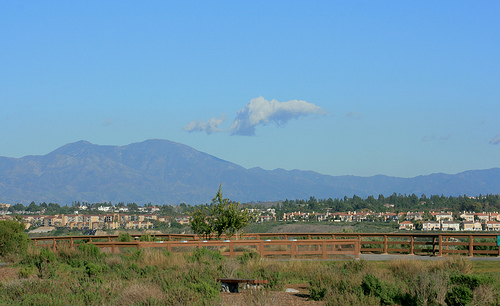
Today, Sunday, I was up with the lawn sprinklers and the house-maids, that is even before the joggers, in this rather pleasant part of LA in which I am staying ...... 

I find it rather sweet the way these palms all lean towards the south!

I set off on a journey of ecological exploration, and found a sad story of social exclusion and control.

I drove through almost empty streets on my first visit to down-town LA, not three miles distant.  I was very glad for the lack of cars when I encountered the many-layered complexities of the town centre, with all its fly-overs and underpasses and god-knows-what to confuse the new-comer.

Fortunately Third Street took me directly to my destination, Bunker Hill, where I had heard that there is a small park so steep that only goats can do the landscaping, as a small flock from San Diego did this week.

Here are a couple of them, getting down to work, with Price Waterhouse Cooper in the background.


LaMaCod.  Downloaded from Flickr under Creative Commons license

It's the third year at this gig for the weed-whacking goats, but sad to say, it may be their last.  It seems that the park is another example of the ecological depredation I have been mulling in connection with Newport Beach (a couple of posts back), which is why I came to take a look.

Check out the goat story.  it's really quite cute.  It seems that they saved the taxpayer $3000 over more conventional weed-control methods (i.e. in labour costs), and also, as one homeless person who lives in the neighbourhood said, they make everyone more friendly.....

For me the kicker was the last sentence of the goat story, tossed off lightly and without comment, where surely comment is due: the area will soon be developed.

No matter what small amount of social benefit is provided by this little patch, it will soon be crushed by the great god Mammon.  However, I found the situation to be much worse than even I had expected.

Angel Knoll, as the little park is called, occupies an escarpment which has for a long time marked (as they often do) a social as well as a physical boundary: in this case between an historically elite area of LA and the more poverty-stricken miasmas of the flatlands below. 

And this is still apparently the case, but in a new and desperate way.

At the top of the hill and to its west, once a residential area, are now to be found such entities as the luxurious, palm-fronted Omni Hotel, the super-shiny Price Waterhouse Cooper, shown in the above photo and on the right below, the striking and lovely Walt Disney Music Center, and others of similar stripe, many grouped around a pleasant water park.


Omni Hotel

 Walt Disney Music Center

However, if you look the other way, towards the east, while no longer exactly impoverished, the area is markedly less up-scale. 

LaMaCod.  Downloaded from Flickr under Creative Commons license

It is here, among these buildings right in the heart of LA, that many, many (tens of thousands), homeless people live.

Strangely enough, this clear socio-geographical distinction is echoed in the park itself, which is divided in two.  The upper part, the elite westerly part, is watered, green, planted with shady trees and provided with benches.


The lower, easterly part, seen here now neatly nibbled by the goats, is the part closest to the homeless people, and is completely free of any amenity (except free wi-fi, but that's a joke, surely). The luxurious trees you can see in this photo are in the upper, more westerly part of the park.


The two are divided by a fence, and a further fence surrounds the whole, forbidding and exclusionary, especially in the more desirable portion.


The single gate to the park is hidden away at the upper-most  corner of the park: convenient for the office workers above to have their lunch in, less so for the homeless people living in the streets below. 

It is approached from below by a rather forbidding flight of concrete steps, almost hidden beside the little railway for the tourists (originally built to help servants move from their homes in the flatlands to the elegant workplaces above).


Try going up that with a shopping cart, I thought.

You can't see the gate very easily from the top either, but it's there, underneath the California Plaza building, if you can spot it beyond the staircase, behind the palm tree.


But to get back to my story.

I drove down the flank of the escarpment on which Knoll Park lies, moving from west to east, past the pleasant and then the arid sections of the park.  It was around seven o'clock this morning when I turned right onto Hill Street, which runs along the base of the escarpment, and past famous Pershing Square.

The whole street and its environs were astir, totally astir, with people waking up, packing their belongings, yawning, stretching, pushing their shopping carts, stowing blankets in rucksacks.  There was a marked busyness and purpose about all this activity, particularly startling compared to the stillness of the streets I had just left.

Most shockingly I saw a person asleep in a wheelchair, in a door-way with a blanket pulled up over his head.  I can hardly imagine living on the streets at all, let a alone in a wheelchair.  And sleeping in a wheelchair every night?  Crikey, that's all I can say to that. I don't mean to be facetious, but words completely fail me here.

In addition, many showed signs of other disabilities: mental illness, and all the exhaustions and despairs of addiction.  How many are disabled in some way I thought.  I wonder what services they have access to.  It turns out that a major, perhaps the only, service that comes to them actually favours the rich.

Not all appeared to be long-term denizens of this zone: I saw one tall young man, neater than many of the others, praying with his palms up-turned, who had a suit, protected by plastic wrapping, swinging desperately on a hanger at the back of his ruck-sack.

In the space of 2-3 short blocks I think I saw upwards of 200 people, of which perhaps a quarter were women, busily engaged in packing up the evidence of their existence.  I parked and walked around, moving through the community as if in a different dimension, which of course I am.

Soon I saw the reason for all this activity - two agents with the words "neighborhood security" emblazoned on the back of their shirts, smartly uniformed in purple, lightly armed and equipped with very nice bicycles and various other accoutrements of authority, were waking people up and making them move on.  How callous they seemed, how insolently they stood and watched a man getting dressed on his bench.


By eight o'clock the streets were quiet again, ready for the tourists.  Many of the former sleepers in fact looked very much like tourists themselves, with back-packs, wheelie-bags and not much else, anonymously and ironically blending with the affluence surrounding them.

Life in this part of the world is strikingly luxurious for many, but extremes of poverty are so close to the surface, and unemployment growing so rapidly, that one wonders how it can all be contained.

Three things come to mind:-
  • Ideology: The American Dream, a ruthless two-edged sword replacing any notions of collective entitlement with exclusion and desperation, is nevertheless a powerful opiate; 
  • Intoxication: And then of course the real opiates, the cheap narcotics with which LA is awash greatly assist; and 
  • Force: let's not forget the critical element of control (not to mention fear and loathing), AKA in this case "neighborhood security".
Shortly afterwards I sat outside a very nice coffee-house on the edge of this neighbourhood,  just west of Pershing Square (drafting this blog as a matter of fact), and a young woman passed out at the table next to me.  A family with teenage children waiting for the lights to change nudged each other and laughed.

One of those two purple-clad bozos on bicycles turned up and shook her awake. She roused herself and walked unsteadily away, muttering abuses at him and us.

Not long after that, as I still sat there, two young men occupied the same table, apparently in the aftermath of a one night stand.  When the one that was dressed in flowing black priest-like robes walked away, the other, who had a huge suitcase with him containing only a sleeping bag and a few bits and pieces of electrical equipment (I know because he opened it up right in front of me), went into an emotional melt-down, weeping, pacing up and down the sidewalk and shouting at all around. It appeared he had not been paid.

The management called the authorities, and the very same cyclist arrived back again and took the young man away.  About half an hour later the poor fellow returned, without his suitcase, opened the door of the coffee house and shouted that everyone should boycott the place.

It was a totally ineffective act of defiance.  By that time there had been an almost complete turnover in the clientele, and no-one except the staff and I knew what he was talking about, and the staff just laughed, along with everyone else. Laughed rather nervously I thought: perhaps because they may be only a low-paid "job" away from the streets themselves.

What an important function these drugs fulfill: further disempowering vulnerable people where there should be solid programmes and services to remove poverty and joblessness, but which cannot be provided because, despite all the wealth around, the tax base is just way too small relative to the need.  The costs of those two cyclists tasked with keeping street people as much as possible out of the eyes of everyone else is negligible compared to what should be in place. A total travesty of an equal, free and decent society is revealed.

Well as I know that the USA is the most unequal of any OECD country, I was shocked to be confronted by the reality.  This was without doubt the most unabashed, in your face, front and centre poverty and oppression that I have seen in any major western city: utterly shameful in a city so rich, so engulfed in conspicuous consumption.

The only difference between this and a third world city (of which I have visited over 100, according to a FaceBook widget) was that there were apparently no children: in this at least LA holds back from absolute barbarism, but that is not much to say for the richest city in the eighth largest economy in the world (California).

And yet social struggle around Bunker Hill seemed very muted, very puny, very subdued to me, at least on that particular Sunday morning, although heaven knows, day-to-day living on the street must certainly be enough of a struggle for the extremely deprived. But where is the broad movement that understands this situation, that can advance their interests?  What has happened to the upswelling of hopes that put Obama in power?

I know there are committed and principled organisations representing the interests of the poor and deprived, but why is it so hard for them to gain traction, to gain political weight and momentum in this country so committed, in fine words, to "equality" and "democracy"?  Here I do not mean to sound naive: I am being rhetorical. It is a history of vicious attacks, supplemented by a suffocating ideology and attrition, about which I need to know more.

Without the solid foundation of a political movement behind him, Obama's progressive politics have just shrivelled away in the heat.  Perhaps "evaporated" would be a better term:  "shriveled" implies at least a prior state of solid substance. Compare this, for example, with Lula, by no means a revolutionary, who has made similar compromises with the world financial barons, but has nevertheless maintained in Brazil, with the active support (and let's be clear, pressure) of his constituency, a much more vigorous social contract, while at the same time getting out of recession rather quickly (relative to UK and US, that is).  At least inequality is declining in Brazil.

I got back into my car and drove westwards to another escarpment, this time dividing the merely wealthy from the incredibly super-rich (and incredibly under-taxed).  The fabled slopes of Beverley Hills float like an Avalon above the coastal plane of Santa Monica.  Here, at a bend in Sunset Boulevard is a cinema, where I went to see a film, South of the Border, to see what it could tell me about the limitations of social struggle in Amerika.

Not much as it turned out, being sadly more focused on individual leaders (and on Oliver Stone himself) than on the movements behind them.

More is to be found elsewhere, for example in What is living and what is dead about social democracy.  This is a paper by Tony Judt, in the NY Review of Books, which explores the dissonance in US thinking between being basically fairly liberal and wanting a decent society for all, but definitely not wanting taxes for oneself, and why the latter wins out.  Says it better than I ever could.

And the same political dissonance, er ... confusion, has been found in UK, on which the ConDem's will soon be building their terrifying edifices of disempowerment. It's pretty bad there already, with rough sleepers and disabled people, among other populations, seriously under-served and neglected.  How will we resist a similar fate before all the assaults on our welfare state that are in the pipeline?

To this question, of course, there is only one answer: organize. The question is, will the rate of organization outpace the accelerating efforts of the government to demonize the disempowered, in the ways that have been so very effective in the US.

Update: January 26 2011

Six months later, listening to Southern California national public radio KPCC in sunny Newport Beach, I hear a programme entitled Homelessness in Los Angeles: The Safer City Initiative.  Turns out that I was in Zip Code 90014, the actual, original Skid Row.  More accurately, I was on its outermost edge.

According to this excellent programme, the city fathers have been trying to address homelessness  (AKA pander to voters) with a heavy police presence, sending rough sleepers off to jail etc. etc.  and have thwarterd the efforts of more principled people trying to provide services to the vulnerable and desperate people living there.

It seems that the two-man "Neighborhood Security" team I had seen were were part of a much bigger planned programme of heavy handed policing.  It has not been a success, according to the programme.  No surprises there.

However, it is clear that there is at least a debate, in some circles, about the best way to solve homelessness: but its also clear the public is just not with this issue.

Update July 9 2011

In light of this debate its at least somewhat interesting the Will&Kate have chosen to visit 90014.  Its in line with his work on homelessness in UK, and perhaps will give the debate a broader airing than is usually possible, as summarised, for example this LA Times piece:  Royal Visit - making the most of Will and Kate's Skid Row photo-op.


Tuesday, 6 July 2010

Tea in the Garden

Somewhere in LA, a lovely garden.


And fortunately its tea-time ......


Nothing like tea in the garden to restore the soul.

How lucky I am to have a loved and generous friend-and-relation with a house that I can sit in while she is away.  Thank you darling!

________________


If you liked this, you may also enjoy:  A garden: the best damn reading spot in the world

Friday, 2 July 2010

The Trees of Orange County

As I mentioned in my last post, there is quite a bit of concrete in Newport Beach.  At least two thirds of the town is covered in the stuff. 

But there are loads of trees, and they have really knocked me out.

When you look at them individually, they are amazing - some with smooth thick bark like an elephant, or ribbed like a crocodile: some flaky as old paint.


 Pink and blue and green


But when you see a mass planting, that is something else altogether:


By Nimisha Prasanth Pookal (flowers)
downloaded from Flickr under creative commons

By Nimisha Prasanth Pookal (flowers)
downloaded from Flickr under creative commons

I just love them.

But my favourites are two little old olive-type trees outside my daughter's apartment.  They are pretty dull, frankly, as trees, although one has a lovely knarled old trunk, and the setting is unremarkable, but they are completely full, all day long, with tiny humming-birds, just doing their thing, whatever humming-birds do.

Mostly they seem to be engaged in full and frank exchange of views, and active conflict resolution.  They seem to be rather assertive, and yet highly defensive little birds.

This suits my current mixed mood, and I love them for that.


By Nimisha Prasanth Pookal (flowers)
downloaded from Flickr under creative commons

Stunning!

Wednesday, 30 June 2010

Five things I like about Newport Beach (but three things not so much)

So far, I have divided much of my life between UK and the Eastern Seaboard of the United States. Now for the first time I am spending time on the West Coast – Orange County to be precise. Its pretty much ground zero for affluent republicanism, but still, in many ways I’m feeling really lucky, in fact privileged, to be here.


See what I mean?

Been dealing with a bit of family bovva, from which we are all now recovering, and there are few better places for recovery than Orange County, CA, or, as we say over here, the OC.

For starters, there’s the weather. It’s almost perfect – around 21 C or, as we say over here, about 70 degrees. There is “June Gloom” at the moment, which means seasonal cloudiness, which is fine by me as it keeps the temperature down.

But mostly its like Nairobi – fine, cool-to-warm and sunny, with no humidity, and I find myself muttering each morning, with Isak Dinneson, “Oh no, not another f**king perfect day”. Except that I’m not bored, in the slightest.

Secondly there is the friendliness. People here find it much easier to talk to strangers, even easier than New Yorkers do. It’s very refreshing, and when in Rome I find myself able to do as they do. Surprising, and very nice.

Thirdly there’s the retail therapy. This place is built for shopping. Honestly, it feels like Stepford Wives on wheels, not to mention steroids. Socking great six lane roads, I mean highways, with additional left and right turning lanes, and women (mostly) in SUVs, loads of them, cruising along at the mandatory 40 mph, going to get their stuff (at least in my imagination). 

For me its not so much the retail therapy itself, I haven't been doing much of that, but how easy it is to get around.

Everywhere you want to go is easy to turn into, easy to park and easy to get out of, once you understand all the signage, of which there is much.  Its a completely different driving culture to UK - the lanes are not so much about speed as about exit - its all about being in the right lane for the next turn you want to make, and the one after that. 

It all makes moving around generally very easy (provided you have a car), which has its charms, after the congestion of UK (if I don't think of all the petrol, I mean gas, we are burning off, or the scandal, in this day and age, when we know what we know about carbon emissions, of the almost complete absence of public transport).

And there are acres and acres of car-parks, or as we say over here, parking lots. And they are all completely free.   

South Coast Mall, Costa Mesa, CA.  Orange County Archive

It's sad though.  Newport Beach is mainly built around a natural harbour, with all its islands and inlets  rationalised and now encrusted with mansions, slipways and yachts.

 Newport Harbor from the Air, by Kenjet

This used to be the estuary of the Santa Ana river, which in the early 1900s was diverted, sheathed in concrete and now debouches about half a mile to the north, as you can just see in the photo, while the former wetlands are given over to more productive uses - high-end services, dense  and mainly unattractive but nonetheless extremely costly housing and, as I say, acres of highway and parking lot.

That was quite a little land-grab from the collective commons!

Which brings me to my top favourite thing about Newport Beach: a little piece of land that was not stolen away.

In the midst of all this concrete and conspicuous consumption is an oasis called Castaways Park, which is a conservation area for native species.  It is on a bluff,  and has a striking view over yacht and mansion, highway and inlet.  This little sanctuary (25 tiny acres in all) is the object of my daily walk, and the fourth really good thing about Newport Beach, and the one I like best of all.  Check it out.

The park is adjacent to another small ecological preserve, this time the immediate margins of Back Bay which were saved from development by a huge struggle in the 60s and 70s, during which the land, already beleaguered by development, was wrested from the rapacious Irvine Company and assigned to public ownership   Thank goodness for that.  

Back Bay, Newport Beach, From Castaways Park

 Back Bay, Newport Beach


Back Bay, Newport Beach

And the fifth good thing is the ocean itself, which is totally lovely, especially the beaches. Swooping down the Pacific Coast Highway (or as we say over here, PCH ) listening to the great Ira Glass and “This American Life”,   on my way to a meeting in Laguna Beach, can’t be bad! Walking on the cliffs above Crystal Cove is also totally wonderful.


 Crystal Cove: sand, sea and millions of birds.  by Zelkova

Pacific Coast Highway, Near Crystal Cove


On the downside, in addition to the gross over-development of the place, and directly related to it, in Newport Beach I feel distinctly odd doing my favourite thing – walking. Its been said before, but here the car is king, and the pedestrian a rare bird, unless you are poor or jogging, or moi.

Secondly,  on the downside, and deeply shocking considering the wealth around here, there is no re-cycling of rubbish, (or, as we say over here, trash), unless you make a call to the Office of Sanitation with a specific request. I kid you not: no re-cycling in this day and age! And when you think of all the shopping that’s going on …..  my mind is boggling.

And right now a third major downside is that it’s virtually Wimbledon-free (except for a few brief bursts of that most perfect American icon, John Isner) and that’s driving me totally nuts, especially in the second week.

But still, I'm feeling lucky to be here, and mostly that's down to the weather, and the  lovely, generous , welcoming people that I have met, and the tiny miracle of serenity, Castaways Park.


The view inland from Castaways Park


Cycling in Castaways Park


I have to thank Nimisha Prasanth for all but two of the pictures in this posting.  She posts on Flickr as pookal (Flowers).  She is a wonderful photographer who has captured Castaways Park and its surroundings as I see them, and I love her for that.

Monday, 17 May 2010

A Moment of Truth


A couple of posts back I wrote about a moment of connection, joy and delight between father and daughter that can expand to last a life time (A Magic Summer Evening Long Ago).

Then by twitter I received this wonderful photograph which captures so perfectly what I stumbled to express in words.  The very moment of shared recognition. 

What a lovely picture.  I am without words.


The photograph is by Natasha Badhwar,  a writer, teacher and film-maker who tweets with astonishing clarity and beauty.  If you are not already following her you should seriously consider it.  Your life would be enriched.  @natashabadhwar.  

She has kindly allowed me to share this picture with you.

I am lucky enough to have a picture of such a moment between my own daughter and I, when she was very young.  You can find it here.

Friday, 23 April 2010

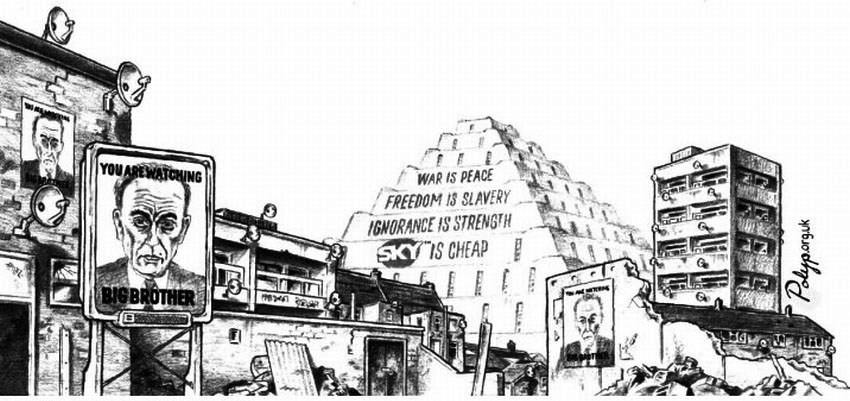
Kiss Goodbye to Sky TV

In view of current interest in Murdoch and his hellish empire, I am re-publishing an old post from way back in November.  Cutting loose seems like a pretty darn good idea right now.

But even more than your monthly subscription, gratifying as it may be to close that out, try not to vote for any party in which his grubby fingers are dabbling, or at least challenge your candidates on what he's up to with their party.

This is mainly for the limeys, although others may appreciate the sentiment.

Don't give any more of your precious money to that jackanape Rupert Murdoch, who has plenty to be getting on with, and gives such shocking service for the monthly payments he takes off us (so easy to open an account, so hard to close it).

Plus, in my humble opinion, Sky News, along with bed-mate Fox TV, is exceptionally economical with the truth.  And I would actually say, informally, strictly from my own observation, that this is an understatement, to say the least.  But it would take a Mori-poll to check that out, and I bet he could even get round that!

Now, I know I'm showing my age here (see "how not to act old" in my blog list), but I only watch the Freebox channels, and these are not only better (except for the crap), they are free.  All the other channels are pretty much full of trivia, sit-coms and general mental rubbish and pollution, in my jaded view (except for the Simpsons, and the Dog Whisperer), and why the hell pay for  crap if you don't have to?  You may well ask.

What would I miss?   The news channels of course, especially Al Jazeera, which is truly fabulous.  But there is plenty of news on the The Freebox Channels, and on the internet now, so that's sorted.

The only thing I really will miss is recording, and speeding through the ads.  Come to think of it, recording is getting to be absolutely essential in the battle against consumerism, but like  the makers of IEDs  they are jumping ahead of us technologically, with all this product placement ....

Actually, it feels like the dark ages now not to be able to record, and giving that up goes right up against my principle of forging ahead on all fronts technologically.  But if it gets me out of the clutches of Skye TV, seems like a pretty decent compromise.

Especially as I can check out freecycle to see if I can pick up a digital recorder.

But even if I were to miss a few channels, the real thing is that I am getting really pissed off that any of my precious boodle, for which I have struggled mightily in this tough world,  should go anywhere near that dark force and his hellspawn, helping them do the damage that they do to our hard-fought and much threatened freedom of speech and information every single effing day.  I won't miss that feeling.

Earlier today I googled  "television" with "I feel Lucky", and what did I get?   You guessed it, Sky TV home page.  Don't waste your time.  Its freaking everywhere.


s

Tuesday, 20 April 2010

A Garden: The Best Damn Reading Spot in the World


It’s that time of year again.  Reading in the Garden.

Here is my spot at lunch-time on a warm day last week


Here it is this evening, with a nice mug of tea ...


And magnolias in full bloom ..


And here's my view, with primroses and everything greening up nicely ....


Oh dear.  All the moss has been spring-cleaned.  But it'll grow back.

And its still the best damn reading spot in all the world, bar none.

Except yours, of course  ......

Oh, and by the way, what's the latest entry in the hilarious blog "How Not to Act Old"?   

"Don't Take Pictures of your Freaking Flowers".  I kid you not, and she's quite freakin' right.   Its a very old-acting thing to do.  We're all at it, as Spring moves in again.  Check it out.


P.S.  can't resist it, old-acting or not. Here's a view of the evening sky taken from that chair one evening last June.  Not so many vapour trails about today!  But they'll be back, like the moss, only quicker.


And here it is!  The first one, taken about 05.15 this morning (a bit faint because of the dawn light).


I can't BELIEVE that I'm dealing in this total ephemera.  Un-freakin'-believable.  Havn't I got better things to do?

Yes, indeed.  It's called reading.....


Sunday, 11 April 2010

A Magic Summer Evening Long Ago


I like Saturday Live on BBC Radio 4: always interesting conversations with interesting people.  This Saturday, in the midst of all this interestingness, one phrase really resonated.

“We've all got that little bit of magic, that stays with you all your life ... a place of inner calm and happiness", said actor Charles Collingwood (Brian Aldridge in The Archers).

I hope its true that everyone has such a place.  It is true for me, and it's this place.


Nothing remarkable in this view you might think, and you would be right, but for me it embodies thirty seconds that have shaped my entire life.

I was five years old, and had just finished my bath.  My father wrapped me in a towel and lifted me to a chair beside the bathtub, so he could dry me.

I looked at my small brown hands gripping the wooden chair back, and then up my father and then through the open window, where I saw approximately what you see in the picture.

It was a summer evening, so the sun was slanting in from the left, full onto the Down.  (Middle English “Doun”: a hill.  Similar to the modern “dune”, as in sand-dune.  A rounded, chalky, mainly treeless hill in southern England).

It must have been a weekend, (a) because my father was bathing me, and (b) because that  is the village cricket field in the foreground, and there was a game going on, with long evening shadows cast by the pavilion and the players, the bang of bat on ball, and gentle cheers and clapping every now and then, as a run or two was scored.  Beyond the field I could see the wooded dip where the little river ran, the low, flinty, grey village school on the hillside, and the ancient hollow in the flank of the Down, which we called “the vineyard”, a sun-trap where the Romans used to cultivate their vines, so we heard.

I knew that hill well.  Sometimes we took our jam sandwiches, wrapped in greaseproof paper, and climbed to the top for the wonderful view back over the valley and our house. It was a hard, steep, tussocky climb for little legs, up through the shady churchyard and onto the wide open hill, under the sky and song of the skylarks.  The sun was always burning hot up there, so my memory goes.

Sometimes we didn’t make it to the top, and sat in a row on one of the little paths worn by centuries of grazing sheep, like contours, almost like steps, into the side of the hill, with our plimsoled feet resting on the path below, the backs of our bare legs scratched by the grasses.  Close to the ground,  we could hear the summer insects buzzing among the thick, sheep-cropped chalkland plants, full of little flowers miniaturized by all those eons of nibbling.  In the time-honoured way, we could lie on our backs and gaze upwards, trying to see the skylarks, or roll over and peer into the tiny, shady, busy world among the grasses.

Looking up, we could see clear across the village below, the beloved stream running through it and the green fields and hedgerows all around, to another row of Downs to the south of us, with great Butser Hill  like a rampart to the east.  Sometimes, shading our eyes with our hands, elbows on knees, we could see the glittery sea far, far in the distance.   Sometimes an ancient green bus trundled with glinting roof along the dusty road by the edge of the hill, and stopped right outside the school below us, on its way to Petersfield, where I was born.

All this I knew about the hill, in the moment that I looked at it in the evening sunlight, and heard the gentle cricket sounds below, and laughed at my father's silly jokes as he quickly dried me. 

Standing on my chair in the cool, blue bathroom, I remember that a swallow swooped over the field, from the direction of the hill, and into her nest just above me, under the eaves of our house.

But what I remember most is that I was bursting with happiness to be with my father, and, very best of all, I knew that  he was happy too, as he carried me smiling into the bedroom I shared with Andrew, age four, for a bedtime story.

And ever since then I have loved the Downs, the "sunlit uplands" of churchillian fame,  and quiet summer evenings when the air-pressure is high and the swallows are swooping, living their lives.  I have loved looking outward through windows:  I have found that an outlook, a view, is necessary to me.

Many people love these things of course, but for me they are the frame of security itself. They take me to my own foundations.

And how extraordinary is the elasticity of time and place when it comes to the emotions!  Those thirty seconds encompassed me, my father, the Down, its life and its place in my life:  they lasted half a minute, and a whole lifetime.  Sheer magic!

Thursday, 11 February 2010

Alexander McQueen: Why I'll Miss Him


Alexander McQueen. High Heeled Shoe 2009
Flickr Creative Commons


The death of Alexander Lee McQueen so shocked and upset and touched me that I left my deadlines to spend an hour or so that evening setting up a post, just a few pix, to express my feelings.

Next morning I took it down.  "What am I thinking?" I thought.  What exactly are my feelings?

You see, my formative years were spent in the women’s liberation movement, which still has a beating heart.  We had then, and still have, concerns about the objectification of women.  And here I am, wanting to comment on the death of someone who made his living by objectifying womanhood, if not women themselves, sometimes in the most extreme ways.  I cannot let that go by me.  I have to interrogate myself on that one, I thought.

He was at the pinnacle of a profession about which one must ask questions, and he seemed to be asking them.  Nevertheless, he was hailed as a genius by even its silliest propagandists, sycophants and hangers-on, those one would most want to question, as well as by its serious and thoughtful adherents. Did they not see the questions, or where the questions not there?  Did they not see the anger? I am quite perplexed.

So today I have to spend another hour thinking about that, sorting it out and re-posting.

Now (full disclosure), I am not a fashionista, or even minimally fashionable, come to that. Those who know me might chortle at the thought.  I don’t read the magazines that peddle destructive fantasies to women, nor even flick through them in waiting rooms. All that stuff made me very unhappy once, and I totally reject the rampant consumerism that they promote.  Today I dress for comfort not for speed.

But fashion is not simply clothing (and perhaps on the catwalk its not even clothing), its also art and creativity,  and something about this guy's work got to me.  There is social commentary,  less widely noted than the brilliance and originality of his styling, but the fact that it reached me, about as far from the fashion world as it is possible to get, is evidence in itself of the power of the message, whatever it is.

His work is very, very edgy: teetering like his models at the boundaries of composure, terror, glamour, melancholia, sexuality, the macabre, the sweet and the terribly painful. This teetering is interesting in itself: he manages to convey so much contradiction and complexity, to use the extremes of his industry to criticize it, and to suggest, more than suggest, that things are not quite right, not as they aught to be. 

He was part of Claire Wilcox' hugely successful exhibition on “Radical Fashion” at the Victoria and Albert Museum for the Decorative Arts, way back in 2002.  His models were in glass cages, and thousands of moths were released   Moths?  *blinks rapidly*!  Talk about a many-layered metaphor!

And take a look at this little number, that is so sweet and lovely in concept, and yet so strangely armoured and tense in execution, so threatening.  There's a dissonance there: hard to define, but definitely there, I think. That is what he does - makes you feel uncertain.  And yet a beautiful dress, beautifully made.


And then there are those astonishing shoes of his.  So incredibly extreme and high and sexy, so odd, so puzzling, so outrageous and glamorous, but at the same time so downright ugly, and hinting at disablement: the club foot, the bound foot, limitations in mobility. And talk about teetering ….

 
 Dazed and Confused Magazine.  October 2009
Downloaded from Flickr

....  hints of stilts, the circus, the illusion, the freak show....


This video is fascinating.  I hope you have time to view it.  Its of his last  show, for Spring 2010.  Maybe you saw it streamed live, in itself an innovation.

In stark contrast to the lovely, feminine and familiar McQueen silhouettes, the parallel (literally) between the models and the cameras (or are they machine tools?), different kinds of automata, each on their respective runways, endlessly mirrored in the backdrop, is shocking, isn't it? And perfectly clear.  It's actually a terrifying image of  the self-absorbed, self-referential elements of the fashion industry, isn't it?

And what about the lightly reptilian fabric, and the distinctly reptilian hair-dos, and the stalking gait of the models, forced on them by the shoes? Combine this with the predatory silhouette of the cameras, like a couple of praying mantis: and we all know what praying mantis do with their own, with those they "love".

And what about this one?  The machine tools, this time spray guns, actually attack the model innocently pirouetting between them in her flouncy white dress.  It's very beautiful and original, and got thunderous applause, but it looks like a gang rape, or at least an absolutely devastating hissy fit.


I know nothing of the theory of fashion, nor much about McQueen or his life, so I should not, but I do, dare to comment: there is something about his attention to both the beauty and the horror of fashion that is important, as well as arresting.  He was angry, in fact I think he was deeply angry, and he was asking very big questions about his industry, from deep within it.

Not questions about the objectification of women, perhaps,  more about the cruelty and rapaciousness of the fashion/entertainment world, and perhaps also, by implication, the society of which it is the expression. This last is perhaps not impossible, although the focus was  clearly his love-hate relationship with the fashion world.

And now it is all in the past. And we are left with an enigma, and the awful tragedy of genius dying way too early.

And, sadly, yet another disturbing example of the fashion industry not looking after its own, even its greatest.

And I'll miss him: he had serious things to say.


Alexander McQueen 1969-2010
Flickr Creative Commons